Unlocking the Magic of Print-in-Place: A Deep Dive into the Articulated Starfish 3D Model
In the rapidly evolving world of additive manufacturing, few innovations have captured the imagination of hobbyists and professionals alike quite like print-in-place technology. Among the most charming and accessible examples of this engineering marvel is the Articulated Starfish. This isn't just a static plastic figure; it is a fully functional, moving toy that emerges from the 3D printer bed ready to wiggle, bend, and play. For anyone interested in modern creativity, STEM education, or simply looking for a unique desk companion, understanding how these models work and why they matter offers a fascinating glimpse into the future of digital fabrication.
What Exactly is a Print-in-Place Model?
To truly appreciate the Articulated Starfish – Print-in-Place 3D Model, one must first understand the concept behind it. Traditional 3D printing often involves creating separate parts that must be glued, screwed, or snapped together after the printing process is complete. This assembly phase can be tedious, requires additional tools, and introduces points of failure where joints might break.
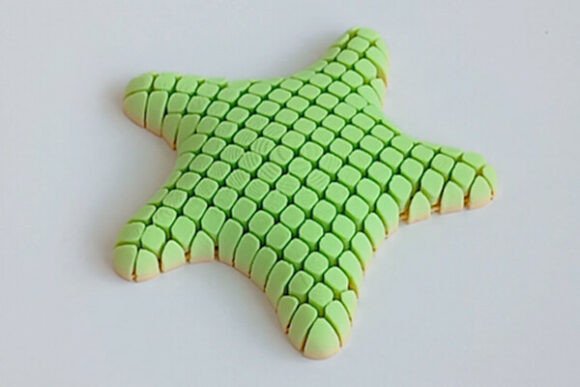
A print-in-place design flips this script. These models are engineered with intricate internal geometries that allow moving parts to be printed simultaneously within a single build volume. The printer deposits material in such a way that tiny gaps remain between hinges and joints, preventing them from fusing together while still maintaining structural integrity. The result is an object that is fully articulated straight off the build plate, requiring no assembly whatsoever. The starfish exemplifies this perfectly, featuring multiple segments that flow naturally, mimicking the organic movement of a real sea creature.
The Engineering Behind the Wiggle
The magic of the articulated starfish lies in its mechanical design. Each arm of the starfish is divided into several smaller segments connected by flexible hinges. When you pick up the model, gravity and tactile interaction cause these segments to shift, creating a lifelike undulation. This design is not merely aesthetic; it is a lesson in physics and tolerance management. The designer must calculate the exact clearance needed between parts so that they don't fuse during printing but also aren't so loose that the model falls apart. For the end user, this translates to a satisfying tactile experience that serves as an excellent fidget model or stress reliever.
Why This Model Matters in Modern Creativity and Education
Beyond being a cute novelty, the articulated starfish holds significant value in educational and creative contexts. It serves as a tangible bridge between digital design and physical reality, making it a powerful tool for STEM education (Science, Technology, Engineering, and Mathematics).
- Accessibility for Beginners: Because the model requires no supports and no assembly, it removes the biggest barriers to entry for new 3D printing enthusiasts. It provides an instant "win," boosting confidence and encouraging further exploration of the technology.
- Understanding Kinematics: For students and makers, dissecting how the starfish moves offers a practical introduction to kinematics—the study of motion. It demonstrates how rigid materials can be arranged to create flexible systems.
- Creative Expression: In a world dominated by screens, holding a physical object that moves without batteries or electronics sparks curiosity. It encourages users to think about how they might modify the design, change the colors, or even design their own articulated creatures.
Furthermore, in a business or office setting, these models have found a niche as unique desk toys. They act as conversation starters and provide a sensory outlet for focus and relaxation, proving that 3D printing has practical applications in daily workplace wellness.
Optimizing Your Print: A Guide to Success
While print-in-place models are designed to be user-friendly, achieving the perfect print requires attention to detail. The difference between a stiff, fused lump of plastic and a fluidly moving starfish often comes down to your slicer settings. Based on the recommended specifications for this specific model, here is how you can ensure the best results.
Essential Print Settings
To replicate the natural bending and wiggling of the starfish, precision is key. The following parameters are optimized for standard desktop FDM printers:
- Nozzle and Layer Height: Use a 0.4 mm nozzle with a layer height of 0.16 mm. This combination offers a balance between print speed and the fine resolution needed for the tiny hinge gaps.
- Material Choice: PLA (Polylactic Acid) is the recommended material due to its rigidity and ease of printing. However, PETG can also be used if you require more durability, though it may require slight temperature adjustments.
- Temperature Control: Set your nozzle temperature to approximately 230 °C and your bed temperature to 70 °C. A textured PEI sheet is highly recommended for the bed surface, as it provides excellent adhesion during the print and easy removal once cooled.
- Speed and Cooling: Print outer walls at 60 mm/s and travel moves at 200 mm/s. Crucially, set your part cooling fan to 100% after the first few layers. Maximum cooling is vital for print-in-place models because it solidifies the overhangs (the hinges) quickly, preventing them from sagging and fusing to the layer below.
- Infill and Walls: A low infill of 5% gyroid is sufficient, as the strength comes from the perimeters. Use 3 perimeters (walls) to ensure the joints are robust enough to withstand repeated flexing.
One of the most significant advantages of this design is that supports are not required. This not only saves material and time but also eliminates the risk of damaging delicate joints while removing support structures.
Troubleshooting Common Issues
Even with perfect settings, variables exist. If your starfish arms are stuck together, your printer might be suffering from z-blobbing or excessive oozing. Increasing retraction settings (try 0.8 mm at 30 mm/s) can help pull the filament back slightly before the nozzle moves across a gap, reducing stringing and accidental fusing. Conversely, if the joints are too loose and the model feels fragile, you might need to slightly increase your flow rate or check your nozzle for wear.
Ethical Usage and Community Sharing
As with all digital creations, respecting the intellectual property of the designer is paramount. The Articulated Starfish model is typically licensed for personal use only. This means you are free to print as many copies as you like for yourself, your friends, or your classroom. You can even sell the physical printed objects in many cases (depending on the specific license attached to the file), but you must never resell, share, or redistribute the digital files themselves.
The 3D printing community thrives on sharing results, not stealing designs. If you print this starfish, the creator encourages you to share photos of your results. Seeing how different filaments, lighting, and printer setups affect the final look fosters a collaborative environment where everyone learns. Whether you choose a translucent blue to mimic the ocean or a vibrant rainbow silk PLA, your unique take adds to the collective appreciation of the design.
Conclusion: More Than Just a Toy
The Articulated Starfish – Print-in-Place is a testament to how far 3D printing has come. It transforms a complex mechanical concept into a simple, enjoyable, and accessible object. Whether you are a seasoned maker looking to test the limits of your printer's tolerances, a teacher seeking an engaging way to demonstrate engineering principles, or someone who just wants a cute, wiggly companion for your desk, this model delivers. It reminds us that technology, when applied with creativity, can bring a bit of wonder and movement into our static daily lives. So, fire up your printer, dial in those cooling settings, and get ready to watch your digital file come to life in the most literal sense possible.