Articulated Print in Place Gorilla: A Durable Desk Companion for Makers and Collectors
There is a distinct satisfaction in pulling a fully functional, moving object straight off the 3D printer bed. No supports to snap off, no glue to dry, and no assembly required. The Articulated Print in Place Gorilla captures this magic perfectly. It is more than just a novelty; it is a robust, engineered figure designed for maximum durability and posability. For anyone who spends hours tweaking slicer settings or browsing repositories for the next great print, this model offers an immediate reward that combines technical impressiveness with tactile fun.
Unlike delicate figurines that gather dust on a high shelf, this gorilla is built for interaction. Its design philosophy centers on resilience. The integrated joints are smooth yet tight enough to hold a pose, allowing for a wide range of motion that feels natural rather than forced. Whether you are looking for a fidget tool to keep your hands busy during long conference calls or a striking centerpiece for your maker space, this print-in-place model delivers on both aesthetics and function.
Beyond the Build Plate: Real-World Utility
While many 3D prints serve purely decorative purposes, the Articulated Print in Place Gorilla finds its niche in active handling. Its primary strength lies in its ability to withstand repeated manipulation without wearing down quickly. This makes it an exceptional candidate for several real-world scenarios where durability and engagement are key.
The Ultimate Office Fidget Tool
In modern workspaces, the need for tactile stimulation is real. Many professionals find that keeping their hands occupied helps maintain focus during tedious tasks or stressful meetings. Traditional fidget spinners can be noisy or distracting, but a silent, poseable figure offers a discreet alternative. You can adjust the gorilla’s limbs, rotate its torso, or simply feel the smooth resistance of its joints while thinking through a problem. Because it is printed as a single piece, there are no small parts to lose under your desk, making it a low-maintenance companion for the office environment.
A Dynamic Display Piece for Creators
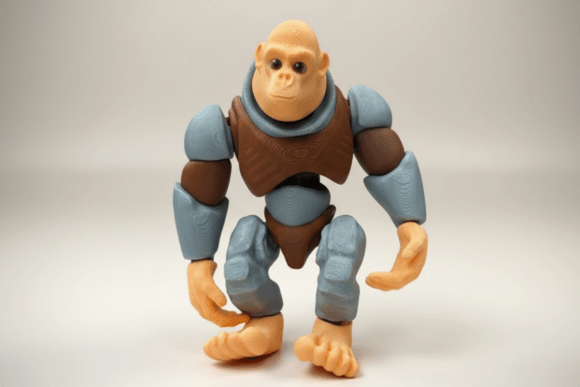
For content creators, streamers, or tech reviewers, background aesthetics matter. A static plastic model can look flat on camera, but an articulated figure adds depth and interest. The Articulated Print in Place Gorilla shines here due to its multicolor aesthetic potential. When printed with a multi-tonal scheme—such as tan extremities, a dark brown torso, and slate-blue limb plating—it catches the light in ways that highlight its complex geometry. It serves as a conversation starter, demonstrating the capabilities of modern FDM printing to visitors or viewers who might not be familiar with the technology.
Educational Demonstrations of Mechanical Design
Teachers and mentors in STEM fields often struggle to explain complex mechanical concepts like joint articulation, tolerance, and print orientation. This gorilla serves as a tangible example of how digital designs translate into physical movement. By showing students a model that moves without assembly, you can discuss the importance of clearance gaps in CAD design and how layer adhesion affects structural integrity. It is a practical tool for illustrating the bridge between virtual modeling and physical engineering.
Optimizing Your Print for Best Results
To get the most out of this model, understanding its technical requirements is essential. While it is designed to be user-friendly, achieving that "straight off the build plate" perfection requires attention to detail in your slicer settings. The goal is to balance speed with the structural integrity needed for those smooth, integrated joints.
- Infill Density: A recommended 10–15% infill is sufficient. This keeps the print lightweight and flexible enough for the joints to move freely, while still providing enough internal structure to prevent breakage during vigorous posing.
- Wall Lines: Using 2–3 wall lines ensures the outer shell is robust. This is critical for the joints, which bear the most stress when the figure is manipulated. Too few walls may result in fragile connections that snap under pressure.
- Layer Height: For a quick print, a 0.2 mm layer height yields excellent results in approximately six hours. If you prefer finer detail and smoother joint surfaces, opting for a 0.12 mm layer height will extend the print time to around eight hours but reduces the visibility of layer lines on the curved surfaces.
- Scaling Considerations: Flexibility is a key feature, but size matters. While the model can be scaled down to 70%, doing so risks compromising joint integrity. A minimum scale of 85% is strongly recommended to ensure the tolerances remain functional. Printing at 100% scale provides the best balance of detail and durability.
Who Benefits Most from This Model?
The appeal of the Articulated Print in Place Gorilla spans across different groups, each finding unique value in its design.
Hobbyist Makers: For those who enjoy testing the limits of their printers, this model is a benchmark for calibration. It reveals how well your printer handles overhangs and bridging without supports. A successful print is a badge of honor, indicating well-tuned retraction settings and accurate extrusion.
Collectors of Kinetic Art: There is a growing community of collectors who appreciate moving sculptures. Unlike traditional statues, these figures invite interaction. The gorilla’s robust nature means it can be handled frequently without the fear of damage that plagues more delicate resin prints.
Gift Givers: Finding a unique, personalized gift can be challenging. A custom-printed, articulated animal figure offers a thoughtful present that shows effort and creativity. It is particularly appealing to tech-savvy friends or colleagues who appreciate the intersection of art and engineering.
Common Considerations and Limitations
While the design is robust, it is not indestructible. Understanding its limitations helps manage expectations and ensures longevity. First, material choice plays a significant role. PLA is the standard recommendation due to its rigidity and ease of printing, but it can be brittle if subjected to extreme force or high temperatures. Avoid leaving the figure in a hot car or direct sunlight for extended periods, as this may cause warping or joint stiffening.
Additionally, while the print-in-place design eliminates assembly, it does require careful removal from the build plate. Using a sharp spatula and applying even pressure is crucial to avoid damaging the feet or lower limbs, which anchor the model during printing. If any minor stringing occurs in the joints, a quick pass with a deburring tool or fine sandpaper can restore smooth motion.
Another consideration is the visual impact of color. While single-color prints are striking, the model truly comes alive with multi-material setups or painted finishes. If you do not have a multi-extruder printer, consider post-processing with acrylic paints to highlight the different anatomical sections, such as the slate-blue limb plating versus the tan extremities. This adds a layer of customization that makes each print unique.
Ultimately, the Articulated Print in Place Gorilla represents the best of what desktop 3D printing has to offer: functionality, durability, and aesthetic appeal in a single, accessible package. It transforms digital files into tangible objects that enrich our daily environments, whether as tools for focus, subjects of admiration, or examples of mechanical ingenuity.